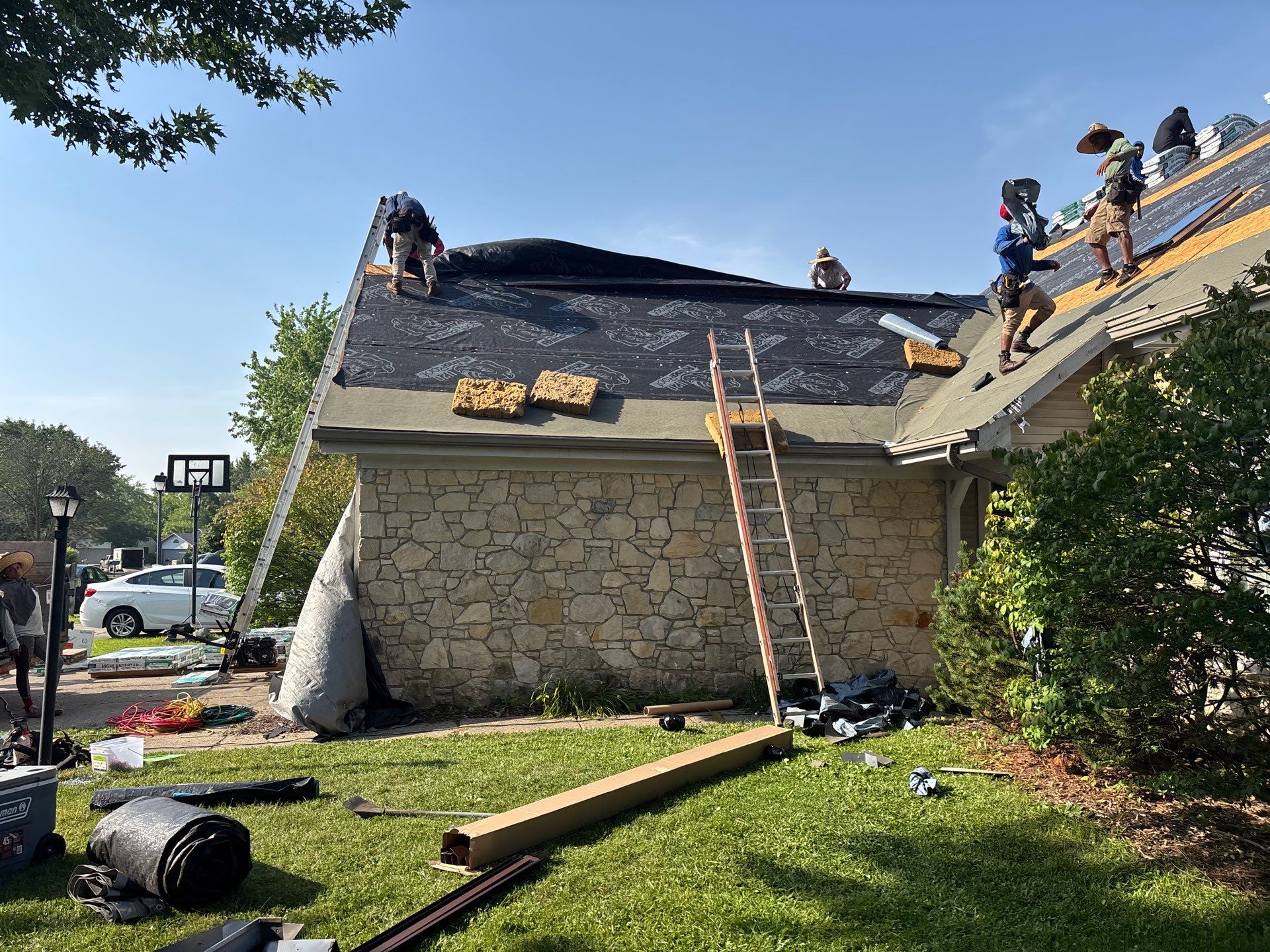
How Heat Actually Breaks a Roof Down
Asphalt shingles are petroleum products. The asphalt itself is the waterproofing layer, and the ceramic granules on top exist to shield that asphalt from ultraviolet light and to dissipate heat. When a roof runs hot day after day, the volatile oils in the asphalt evaporate. The mat underneath becomes stiffer and more brittle. Granules lose their embedment and start washing into the gutters during summer thunderstorms. Once enough granules are gone, the asphalt is exposed directly to UV, and the aging curve steepens fast. A shingle that might have lasted 22 years under ideal conditions can fail at 14 or 15 when it bakes unprotected.
The damage is not limited to the shingle layer. Heat trapped in a poorly ventilated attic cooks the underside of the roof deck, dries out the sealant strips that bond each shingle course to the one below, and accelerates the aging of any exposed nails, pipe boots, and step flashing. If you have ever wondered why a pipe collar cracks open after eight years when the shingles still look fine, the answer is almost always attic temperature. The rubber gasket simply cannot take the cycling. This is often where a targeted roof repair makes more sense than a full tear off, provided the surrounding field is still intact.
It helps to think of a Earl Park roof as a system under daily thermal stress rather than a static surface. On a 90-degree afternoon, the shingle surface on a south facing slope can reach 160 to 170 degrees, and by 3 a.m. that same surface may be down near 65. That swing of roughly 100 degrees happens every single day from June through early September. Every material on the roof expands and contracts through that cycle, and every fastener, seam, and sealant is asked to move with it. The components that cannot move fail first, which is exactly what the inspection patterns below confirm.
The Summer Heat Damage Comparison
The table below lays out what we typically find on Earl Park roofs during mid summer inspections, organized by the component that is failing. Use it to match what you are seeing from the ground or from your gutters against the underlying cause and the likely remedy.
| Component | Heat Damage Symptom | Typical Age When It Appears | What It Means | Likely Remedy | Ballpark Cost Range |
|---|---|---|---|---|---|
| 3-tab or architectural shingle field | Curling edges, cupped corners, heavy granule loss on south and west slopes | 10 to 15 years | Asphalt has lost its oils, mat is brittle, UV is now hitting bare substrate | Full replacement on affected slopes or whole roof | $9,000 to $18,000 for an average home |
| Ridge and hip caps | Cracking, splitting down the centerline, cap shingles lifting | 8 to 12 years | Caps bend over a ridge and flex with heat cycling, so they fail first | Cap replacement if field is healthy, otherwise roof replacement | $400 to $1,200 for caps alone |
| Pipe boots and vent flashing | Cracked rubber collar, visible gap around pipe | 6 to 10 years | Rubber gasket dried out from attic heat below and sun above | Boot replacement, often with a lifetime lead or steel collar | $150 to $450 per boot |
| Attic decking (OSB or plywood) | Sagging between rafters, darkened sheathing, musty smell | 12 to 20 years | Sustained high heat plus trapped humidity has degraded the panels | Partial decking replacement during a re roof | $70 to $110 per sheet installed |
| Ventilation system | Attic over 130 degrees, hot upstairs rooms, high summer electric bills | Any age if original install was undersized | Intake and exhaust are not balanced, usually not enough soffit intake | Soffit vent additions, ridge vent upgrade, baffles | $600 to $2,400 |
| Sealant strips | Shingles lifting in wind that should not have moved them | 10 to 16 years | Thermal cycling has broken the factory seal between courses | Hand sealing if isolated, replacement if widespread | $300 for spot work, otherwise a replacement discussion |
| Skylight seals and curbs | Interior staining, condensation, cracked glazing gaskets | 10 to 18 years | UV and heat have degraded the perimeter seal | Reflash during re roof or replace skylight unit | $800 to $2,500 per skylight |
Reading the Table Against Your Own Roof
Notice how many of these failures cluster in the 10 to 15 year window. That is not a coincidence. Most asphalt shingles installed in Earl Park between the late 2000s and mid 2010s were mid grade products applied over ventilation systems that met code but were not optimized. The heat simply catches up to them on schedule. If your home was built or re roofed in that window, you are in the zone where a professional inspection is worth scheduling before the first autumn storm rolls through. You can request a free inspection and get an honest read on where your roof sits on the aging curve.
The table also shows why component repairs versus full replacement is rarely a subjective call. If you have isolated pipe boot failures on a 9 year old roof with healthy field shingles, replacement is the wrong answer. If you have ridge cap splits combined with heavy granule loss on two slopes and sealant strip failure, you are past the point where patching is economical. Our team at Earl Park Roofing has walked plenty of homeowners through this decision, and we publish clear guidance on the signs your roof needs replacement so you can sanity check what any contractor tells you. If your roof does not need replacement, we will tell you that. We would rather do the right repair now and earn the replacement job in five years than oversell today.
What Homeowners Can Do Between Inspections
Between professional visits, there are a few habits that extend a roof's summer life. Keep gutters clear so trapped debris does not hold heat and moisture against the drip edge. Watch your attic temperature on the hottest afternoons, since anything consistently above 130 degrees points to a ventilation imbalance worth addressing. Check the ground around downspouts after heavy rain for granule accumulation, which is the earliest honest signal that the shingle surface is wearing thin. Small observations, tracked over two or three summers, tell you more about a roof's trajectory than any single inspection ever will.
What Heat Damage Costs If You Wait
Heat damage is gradual, which is exactly why it gets ignored until it is expensive. A roof that is drying out and losing granules will not leak today, so there is no alarm, and the wear quietly compounds through every summer until a storm finds the weakened shingles or the deck below them starts to suffer. Caught early, the response to heat wear is usually cheap, a ventilation correction, a slope repair, a few resealed penetrations. Caught late, it is a full replacement plus whatever interior damage the first leak caused. The math on a Earl Park roof favors looking now, while the fixes are still small, rather than waiting for the summer when the accumulated wear finally turns into a leak. An afternoon inspection costs nothing and tells you which side of that line your roof is on. We would rather flag a slope that needs attention this year than meet a homeowner the following spring with water already in the ceiling.